The Only Way Around is Through: A Review of Crystal Schenk's Artifacts of Memory


Walking into the Linfield Gallery, where Crystal Schenk’s Artifacts of Memory is installed, is a disorienting experience. It is difficult to make sense of what you are seeing. At first, the eye is drawn across the gallery by two horizontal lines of pod-like structures—the top row hung from the ceiling and the bottom row suspended above the floor with near-invisible wire. As you let your eyes adjust, you realize that what appeared to be a two-dimensional line of pods is in fact a three-dimensional haze that fills the gallery.

Schenk, an American sculptor and installation artist, lost her mother to suicide in 2004. She made Artifacts to represent the overwhelming grief she experienced in the wake of her mother’s death. For an artist, there is perhaps no greater challenge than to embody an emotion, to give voice to the ineffable, to bring form to the formless. With Artifacts, Schenk accomplishes this in a number of ways.

In the beginning, grief is sharp, savage, violent. The pods start red at the center, like a wound, and are tightly arranged, unnavigable. If you follow them outward toward the edges of the installation, they become sporadic, fading to pinkish orange and then to white, drained of their lifeblood. Anyone who has experienced a profound loss knows that grief is not linear, that it can feel more like a cloud of heartbreak through which you can move in any direction, backward or forward, up or down, often not knowing where you are headed or where you have been.

You can read the rest of the review at Drain: Journal for Contemporary Art.

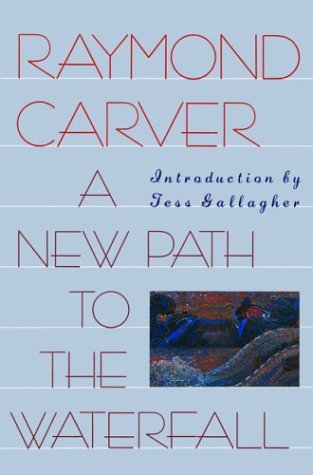
Review: Raymond Carver’s A New Path to the Waterfall


In the introduction to Raymond Carver’s book of poetry A New Path to the Waterfall, the late poet’s wife, Tess Gallagher, explains the collection’s organizing principle. In the days and weeks following Carver’s diagnosis of terminal cancer the two immersed themselves in Anton Chekhov’s work. She writes,

One night I looked at certain passages I had bracketed in the stories and realized that they seemed to be speaking toward poems of Ray’s which I’d been helping him revise and typing into the computer. On impulse I went to the typewriter and shaped some of these excerpts into lines and gave them titles. When I showed the results to Ray, it was as if we’d discovered another Chekhov inside Chekhov.

These “poems” by Chekhov punctuate Waterfalls and create a kind of call and response, a back and forth between Chekhov and Carver. It is a dialogue between the past and the present, between prose and poetry, between two men born a century apart who, through their work, have become contemporaries. The effect is one of inhalation and exhalation. Chekhov, Carver, Chekhov, Carver. One cannot help but notice the beauty of this in light of the fact that Chekhov died of Tuberculosis and Carver of lung cancer, each breathing new life into the other.

By including Chekhov’s work in Waterfall, by giving him a new identity as a poet, Carver proves that there can be life for a writer after death. It is this idea that anchors the collection and, one can only imagine, gives the writer in his last days and the reader a certain degree of comfort.

The reader calls on this comfort to navigate the sixth section of the book, which according to Gallagher, “deals with the stages of [Carver’s] awareness as his health worsened and he moved toward death.”  The first poem, “Quiet Nights,” begins the section hopefully.

I go to sleep on one beach,
wake up on another.

Boat all fitted out,
tugging against its rope.

Carver uses the idyllic imagery of a beach to represent different stages of consciousness, different planes of existence. The boat, his body, is ready to take him there. Racked with tumors, as he knows it to be, it is “fitted out” for the journey into the next life. This boat imagery is echoed later in “No Need:”

I see an empty place at the table.
Whose? Who else’s? Who am I kidding?
The boat’s waiting. No need for oars
or wind.

This time it lends a feeling of urgency, of someone being called against his wishes, of someone who wants to sit down at the banquet table and feast but who is instead being taken away. Carver’s poems fluctuate between resistance and acceptance, another dialogue, which happens between poems and also within poems. “No Need” begins on the inhalation of resistance and ends on the exhalation of acceptance:

Now
let me go, my dearest. Let me go.
We shall not meet again in this life,
so kiss me goodbye now. Here, kiss me again. 
Once more. There. That’s enough. Now, my dearest. let me go.
It’s time to be on my way.

Ultimately, we get the sense that in addition to a great deal of reflection, this time in Carver’s life is filled with a lot of living. In “Proposal,” Carver tells of his and Gallagher’s elopement after finding out the news of his illness, a hopeful gesture in the face of a hopeless prognosis. It is preceded by an excerpt from Chekhov’s “Across Siberia:”

To scream with pain, to cry, to summon help, to call
generally—all that is described here as “roaring.”
In Siberia not only bears roar, but sparrows and mice as well.
“The cat got it, and it’s roaring,” they say of a mouse.

This deliberation of life and death in Waterfall is Carver’s roar. He uses his last breaths to continue working, to continue writing, to give himself, as he did for Chekhov, a chance at rebirth—a life after death.


George Clooney Needs a Nap

In the past few months Whitney Houston, Jessica Simpson, and Lindsay Lohan have all been hospitalized for exhaustion and/or dehydration. I wish their cases were anomalous, but the sad fact is that celebrities have a long history of collapsing -- mid-interview with Jules Asner even -- from these dreaded maladies. Martin Lawrence, Janet Jackson, Michael Jackson, Mariah Carey, and Britney Spears have all been taken by ambulance at one time or another to "rest" and be "rehydrated."

It is curious that our beloved celebrities should be so tired and parched from their day jobs; rarely do you hear of non-icons needing medically supervised rehydration after a hard day of work. I, myself, cannot think of a single manual laborer, construction worker, farm hand, or lifeguard (unless you count Pamela Anderson) that has needed an IV, even after toiling in the blistering sun for twelve hours. This says to me that there is something going on that no one is talking about: the labor conditions in Hollywood are subhuman.

We've done a good job of raising awareness about the labor conditions in far away sweatshops, but we've been so focused on making sure that no five-year-old's hand gets cut off making cardigans for Kathie Lee that we've turned a blind eye to the exploitative working conditions right here in the good ol' U.S. of A. Dear, sweet Angelina Jolie fights for the rights of refugees in third world countries, all the while ignoring the needs of her fellow thespians who are literally falling over from lack of water and rest. Ms. Jolie, if you want to get an idea of the deplorable working conditions in the world you need look no further than Southern California.

To wit: Jessica Simpson was savagely struck down by dehydration while on tour recently promoting her new movie and butt. Apparently, not a single member of her entourage -- not her publicist, not her hairdresser, not her makeup artist, not her manager, not her trainer, not even her goddamned nutritionist! -- thought to offer her so much as an Evian while she was hard at work trying to make the world a more entertaining place in which to live. You would never catch, say, the Tibetan people denying water to one of their most beloved starlets. Imagine the Dalai Lama having to cancel one of his promotional tours because he had no access to liquids. Never happen.

One can only imagine the humiliation and despair these public figures endure when they go back to their trailers after twenty-seven straight hours in the spotlight to find their faucets disconnected and their beds replaced with giant hamster wheels. It is a well-known fact that in between making movies, pauvreGeorge Clooney has to flee the country for his home on Lake Como in Italy, the only place he is allowed to nap.

Someone needs to speak out for our celebrities and to address this epidemic before it spreads to other vulnerable, under-represented members of our society like fashion models and D.J.'s. We must nip it in the bud, thereby sending a message to the international community that this type of exploitation will not be tolerated.

I have decided to found an organization called the Entertainers Rest and Rehydration Relief Effort ("To ERR in Hollywood is human, but to E.R.R.R.E. is divine," the PR materials will read), which will serve as an outreach to our brothers and sisters in L.A. County. Our fleet of volunteers will conduct regular, surprise inspections of movie sets, recording studios, and green rooms to make sure that water supplies are adequate and that each entertainer has access to a cot.

In the past, stars could always rely on unions to secure the types of salaries and nudity clauses they needed to live well-compensated, dignified lives. But clearly the unions have failed to fight for the basic food, water, shelter, and sleep these celebrities need to keep themselves out of hospitals.

I encourage all of you to wage a letter writing campaign to Melissa Gilbert, President of the Screen Actors Guild, to insist that the guild negotiate stricter contracts that will stand up for the basic human rights of its members. If we don't act now, we risk an entirely new generation of exhausted, dehydrated celebrities.

It's probably too late for the Olsen twins. But the fate of Dakota Fanning is in your hands.

Read the original essay at Fresh Yarn.

The World Beneath: A Review


Two of the main characters in Aaron Gwyn’s first novel, The World Beneath, work at a golf course. A fitting setting, for in Gwyn’s world every place, every thing, everyone is full of holes. Literal holes, figurative holes, holes in memory and consciousness, holes in one, tiny holes, big giant gaping holes, holes into which people disappear forever.

The novel begins as fifteen-year-old J.T. goes missing. J.T. is an outcast, half-Native American, half-Mexican, obsessed with the Chickasaw legend of the subterranean creature Shampe: “It is said of Shampe he makes his way beneath. At all times a miner, he comes topside in greatest night or need. He slips through weeds and windows, carries off the wayward child.”

When J.T. disappears, something is triggered in Sheriff Martin, the man assigned to his case. As a boy, Martin’s younger brother Pete disappeared mysteriously while the two were walking the river: “Pete… smiled, edged forward, and then vanished as if through a trapdoor.” Martin tries to fill the hole of his loss by uncovering the details of J.T.’s disappearance. All the while, the author builds a case for the unexplained, the unexpected. He creates a world in which people can fall through the surface of the earth, be snatched by a mythological creature, never to be heard from again.

It is thus perfectly reasonable when Hickson Crider, a war veteran and J.T.’s boss at the golf course, discovers a perfectly formed, seemingly bottomless hole in his backyard. He tries to determine its depth: he throws pebbles down in hopes of a thud, a splash; he ties a larger rock to a two-hundred-foot rope. Nothing reaches the bottom.

The theme of cause and effect runs throughout The World Beneath. Sherriff Martin pursues J.T.’s case doggedly, clinging to the idea that events trail evidence “like the arrowed ripples that accompany fishing lures across a pond. Track the wave and you discover the thing itself.” Hickson, too, is convinced that an answer exists wherever there is a question:

Everything has a bottom…
At a certain
point, boundaries. Things separate and divide.
So everything has a conclusion.
Things don’t just appear.
They have an origin.
Cause.

It is this shared belief that anchors the story, that holds a promise to the reader that an explanation exists for everything, even as circumstances become more and more unlikely.

Researching probable causes for his mysterious hole, Hickson finds reports of underground cities: “You walk on earth that is only a brittle shell. Miners have come from other lands to make it brittle. To make their way beneath you. Because of them, your life could collapse.” J.T., Martin, and Hickson are linked by the hollowed territory, by the world beneath that waits to claim the people above. Though at times this metaphor feels overwrought, too omnipresent, Gwyn successfully imbues the imagery with meaning and uses it to transport us to another place.

The triumph of The World Beneath is its structure, which initially takes some adjusting to but which pays off tremendously. Gwyn unfolds the story through a series of dated flashbacks and flash forwards that make it possible for him to reveal details and motives that would otherwise have lacked suspense presented chronologically.

Gwyn’s language does not always serve the story as best it could—it can be staccato to the point of distraction—but still the author manages to accomplish something extraordinary: to create a narrative that mirrors its greatest metaphor. Reading this novel feels like descending into a hole. It takes at least fifty pages to get going; in the beginning, we are still close to the surface, looking up at the sky, taking in the light. As the story progresses, we lose the light, and with it our sense of what is or isn’t real, taking on the desperate need of Martin and Hickson to get to the bottom.

The World Beneath is in many ways a timely work, coming during a period of great global uncertainty and mirroring our fear that we might slip through the cracks, never to be heard from again. Some of his characters fall too far to be saved; but Gwyn also shows that it is sometimes possible to climb out from the deepest hole before discovering where it leads, before sinking to the bottom.

You can read the original essay at The Rumpus.
Related Posts Plugin for WordPress, Blogger...